Some people find their calling. Bill Cuono was born into his. What follows is the story of a craftsman, an inventor, and a mind that never settled for close enough.
Long before the bench, the CNC machine, and the elevator software, there was Don Bosco Tech High School — and a set of values instilled there that never left.
The Salesian Brothers and Priests who ran the after-school programs offered the kind of formation that is hard to find and easy to recognize in hindsight. Brother Frank Tilton led the groups — by all accounts one of the kindest men anyone had ever met, and a man who had also served as a United States Marine. Kindness and discipline were not, in his world, in conflict.
By around age fourteen, Bill had earned the trust to referee Saturday basketball games at Don Bosco. To referee well at that age requires composure, authority, and a willingness to hold a line when others push back. Bill held it.
Central to that mission, for twenty-five years, was Father Thomas McGahee — Head of Technology at Don Bosco and a renowned Salesian priest who himself built optical systems for NASA and a voting system for the Pope. In his classes, students were given the freedom to build what they wanted to build. Bill worked closely with Fr. Tom throughout those years, and that environment — serious capability, no ceiling on curiosity — proved to be exactly what a mind like his needed.
The Trifari family belongs in this chapter. Edmund Trifari, Dean at Chelsea High School in New York City, understood something that not every educator does: that building something yourself is the only real way to understand it. Under his guidance, Bill worked through a long string of Heathkit projects — hands-on electronics, assembled from scratch, that turned theoretical knowledge into working systems. It was the bridge between studying mathematics and physics and actually doing something with them. That instinct — to build the thing, not just know about it — never left.
Edmund Trifari was also a licensed Amateur Radio operator — a Ham — based in Paterson, New Jersey. His callsign was WA2GBH, and he took quiet pride in what those letters stood for. He always said it himself: GBH — God Bless Hams. It was not just a callsign. It was a philosophy. Amateur Radio operators in that era were trained for exactly the moments when everything else failed — civil defense, emergency communications, the infrastructure that kept communities connected when conventional systems went down. Edmund was part of that network, part of that readiness. It was another dimension of the same man: the educator who believed in doing, now also the citizen who believed in serving.
Edmund also taught Bill Morse code — setting up a Ham receiver and a set of vinyl training records that walked him through the dots and dashes, rhythm by rhythm, until they became second nature. It was a different kind of precision than the bench work, but the same underlying discipline: pattern recognition, repetition, and the patience to get something exactly right before moving on.
There is one more thread in the Trifari connection that Bill would only learn later. Father Aloysius Trifari — Edmund's brother — had been instrumental in the very founding of Don Bosco in Paterson, laying groundwork there more than a decade before Bill ever walked through those doors. The institution that shaped Bill so profoundly had been shaped, in its earliest days, by a member of the same family that would later become one of his most important mentors. Bill did not know that at the time. When he found out, it struck him the way those things do — not as coincidence, but as something that had always been true, waiting to be understood.
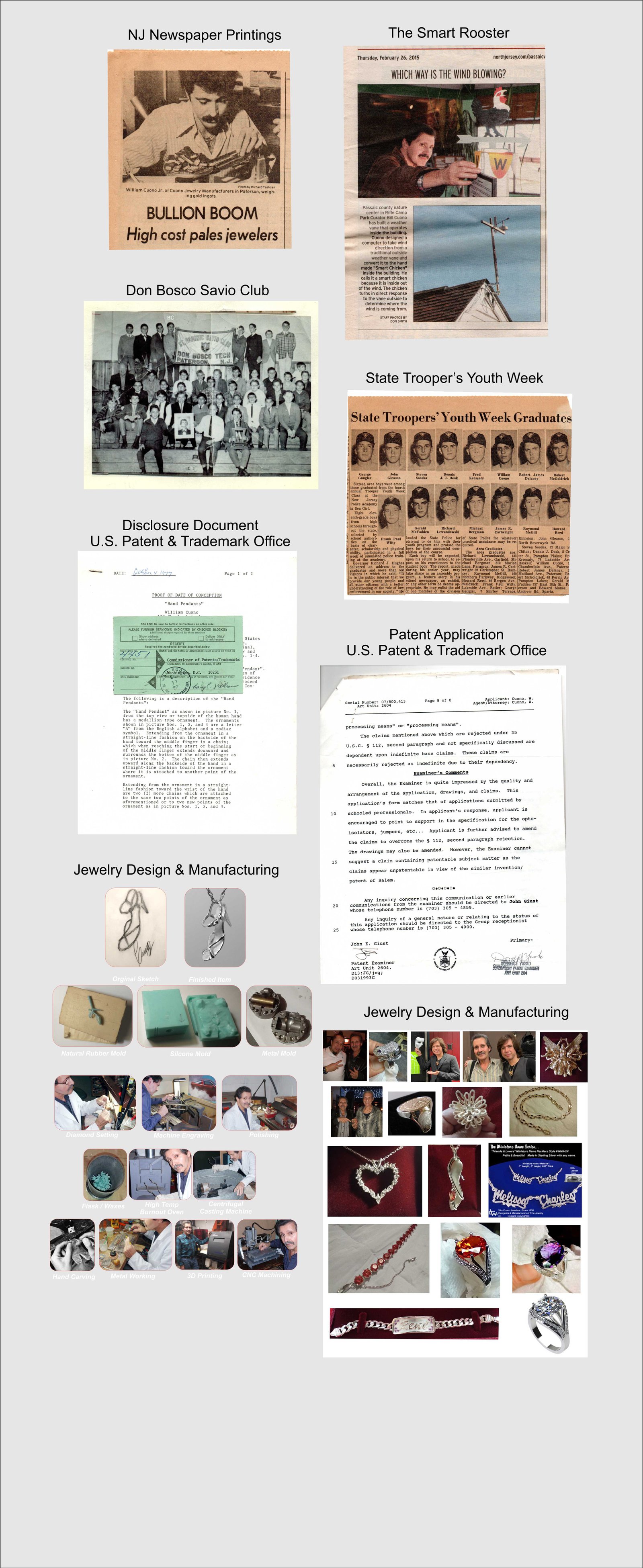
In his third year of high school — 1968 — Bill was selected to attend NJ Trooper Youth Week, a program run by the New Jersey State Police. Selection was based on both athletic and academic achievement, and you did not turn it down. The State Police were looking at young men who might one day be candidates; at the time, eighteen was all that was required to become a New Jersey State Trooper. It was a week spent alongside serious people doing serious work — the kind of experience that stays with you not because of what it led to, but because of what it told you about how others saw you.
During the Vietnam War, Bill was in college pursuing mathematics and physics — the disciplines that had always come naturally to him. He enlisted in the National Guard. He served his hitch. And when it was done, he made a decision that turned out to define everything that followed: rather than continue on the conventional academic path, he would pursue knowledge on his own terms, and turn his energy toward jewelry design, manufacturing, and the apprenticeships that would eventually make him a master of his craft.
Self-directed learning — finding the books, seeking out the teachers, building the knowledge piece by piece without a syllabus to follow — is exactly what he would do again twenty years later when he needed to understand microprocessors. The pattern was already there, established early: when Bill decides to learn something, he does not wait for someone to teach it. He goes and finds it himself.
Bill bought one of the first Fidelity Chess Challenger computers — the world's first commercial electronic chess game, released in January 1977. He took it apart. Not to break it — to understand it. A microprocessor making decisions, working through possibilities, arriving at a move. That question — how does it actually do that? — was the kind he couldn't leave alone.
The Cuono name has been synonymous with fine jewelry since 1936 — three generations of craftsmen who understood that jewelry is not just something you wear, it is something you keep. Bill grew up inside that tradition, trained by his father at the bench, and has spent more than fifty years making it his own.
He is a master diamond setter, a casting specialist, a bench jeweler of the first order. He has mentored professional jewelers, tutored GIA students, and consulted on CAD, 3D printing, and advanced fabrication techniques across the greater New York and New Jersey area.
For ninety years the work reached customers through retail jewelry stores throughout New Jersey, local schools, clubs, and individuals. Retail has always worked — but retail carries a cost. High overhead, a middleman between the craftsman and the customer, and margins that have to cover all of it. Bill is currently exploring select partnerships that preserve the personal relationship retail makes possible, while keeping prices where they belong — closer to the bench than to the display case.
Today he works directly with clients — person to person. The man behind every piece is the same man answering your questions: the design, the process, the standard it's held to. There is no intermediary, and no mystery about where your jewelry comes from.
His eye for design was shaped early. His cousin Peter Cuono — Head Hand Engraver at Cartier Jewelers in New York City for ten years — brought a further influence into the family tradition. Through Peter, Bill came to know Alfred Durante, Vice President of Design at Cartier and the man who designed for Elizabeth Taylor. Durante shared his philosophy of good design directly with Bill, becoming a mentor whose influence shaped his standards for what fine jewelry could be.
"The design and creation process must work together."
Alfred Durante, VP of Design, Cartier — mentor to Bill CuonoThose words were taken to heart. Bill set about mastering not one process, not a handful — but every process required to take a piece of jewelry from idea to finished object. The skill set he built over decades is, in the world of fine jewelry, exceptionally rare to find in a single person.
Alongside the fine jewelry, Bill developed and marketed a separate line in the 1970s — Gol-Quano, an inexpensive line of heavily gold-plated jewelry finished with special protective coatings, sold through a network of independent sales representatives. It was successful enough that demand eventually outpaced what he could produce. The model worked. The lesson stayed with him.
It should also be said: over five decades at the bench, Bill has developed a number of proprietary fabrication methods — precision techniques for working with metals that are entirely his own. The details stay in the shop, where they belong.
Growing up in his father's store, Bill watched one of the very first manual engraving machines arrive — a New Hermes, where you traced brass letter plates by hand to guide a diamond drag stylus across metal. It was precise, it was skilled work, and it was slow. But something about it got into his head and never left.
Peter used to hand-fabricate name plates — cutting them out by hand in a process called saw piercing. Letter by letter, curve by curve, entirely by eye and feel. Bill used to watch and think: could a machine ever do this? Could something be built that matched the precision of a skilled hand without losing what made the work special?
That question stayed with him for decades. In the 1990s, he finally built the answer from scratch.
Not just a machine — a complete precision manufacturing system. He designed and constructed a specialized CNC platform capable of cutting features as fine as 0.015 inches — that's 0.38 millimeters — through 1mm thick sterling silver. He also wrote the software himself: motion control, toolpath strategy, process logic — all integrated into a single unified system built for one purpose: consistent, repeatable micro-precision production, piece after piece.
"Always wondered if a machine could be built to do it better. Took thirty years — and the answer was yes."
Bill CuonoAt the time, nothing off the shelf could do what was needed. So he built what didn't exist yet. That was thirty years ago. The machine still runs.
Even today, a modern fiber laser cutting 1mm sterling silver at 0.015" resolution faces serious physics challenges — melt ejection, taper, thermal distortion. Silver fights back. A rigid CNC system like Bill's removes material mechanically, not thermally, which sidesteps those problems entirely. To compete at this resolution with laser technology would require a precision fiber system costing between $80,000 and $150,000. What he built was not just early. It was engineered around a physical limitation that still challenges modern equipment today.
The CNC system was running. The next question — Bill's kind of question — was: what else could this do?
ID-PJ™ stood for Interactively Designed Personalized Jewelry — and the name said exactly what it was. Not a product line. A rethinking of how personalized jewelry could be designed, previewed, and made, built around a piece of software Bill designed himself: Cuono-CAD Personal.
Traditional personalized jewelry followed a familiar path: a hand engraver sketched a design, transferred it to metal, and cut it out by saw-piercing — skilled, slow work that varied piece to piece. ID-PJ™ changed that. Using his proprietary CNC manufacturing software alongside Cuono-CAD Personal, Bill delivered consistent precision that traditional methods couldn't match.
But the genuinely new part was what happened before manufacturing began.
Cuono-CAD Personal — free, and designed by Bill from the ground up — put real design capability directly in the customer's hands. It used Bézier curves, the same underlying technology found in professional CAD packages, to let you reshape letters, adjust proportions, and make the piece genuinely your own. Most importantly: you could print your design to your home printer at the exact physical size you'd chosen. Not a thumbnail. The actual piece, on paper, in your hands — before you committed to anything. Prices calculated in real time alongside it.
It was early internet commerce, built around a craft that had changed little in a hundred years, by someone who understood both sides completely.
A restless and precise mind does not stop working just because the workday ends. Over the decades, alongside the jewelry — always alongside the jewelry — Bill designed and built things that had no instruction manual, because they had never been built before.
Before "software engineer" was a job title, Bill taught himself embedded microprocessor programming by traveling the entire East Coast, visiting college libraries one by one — reading everything he could find on microprocessor architecture, assembly language, and embedded control. The Motorola 6800, the 6809, their instruction sets, their timing, their quirks. No single school had the full picture. You had to build it yourself, piece by piece, the same way you'd build the systems you were studying. The third largest elevator company in New York City hired him to write the control software for one of the first microprocessor-based elevator systems ever built.
A keyless entry system for automobiles — tap your own windshield in the right sequence and your door unlocked, your alarm disarmed. No signal to intercept, no frequency to clone. He called it Good Vibrations. He applied for the patent. GE had beaten him to it by a matter of timing. The idea was correct. It always was.
Racing go-karts generate electrical noise that corrupts sensor signals. Bill's solution: route every sensor through its own fiber optic cable. Light ignores electrical interference. The signal that left the sensor was the signal that arrived at the microprocessor — clean, accurate, and unaffected by everything happening around it.
Designed and installed at the Passaic County Nature Center — a handmade indoor rooster that follows a weathervane on the roof in real time, turning to match the wind direction outside. Hundreds of lines of custom microcontroller software. Engineering students came to ask questions. The local paper covered it and called it the Smart Chicken. The rooster didn't mind.
Designed, built, and programmed from scratch. Cuts sterling silver to 0.015" resolution. Thirty years later, the machine still runs — and the miniature name pendants it produces remain beyond what modern laser systems can replicate cleanly at that scale.
Filed with the US Patent Office — a charm suspended across the back of the hand between a finger chain and a wrist chain. History, it turns out, had seen something like it before — evidence of similar adornments exists going back centuries, if not longer. None of that was known in 1977, and nobody raised it at the time. Bill arrived at the idea on his own. It sold, it was copied, and versions of it are still being made today. He placed it in the public domain deliberately, forgoing the patent.
These projects did not happen instead of the jewelry. They happened because the same qualities that make someone a master jeweler — patience, precision, the refusal to accept close enough — do not switch off. They find new problems to solve.
There is no shortage of places to buy jewelry. What you will not find elsewhere is the person behind it. When you work with Bill Cuono, you are talking to the man behind every piece — with fifty years of knowledge behind every answer.
Enter Your Access Code Back to HomeOr contact Bill directly — 973-790-9497 · CuonoJewelers@gmail.com